You don’t “see” the IPL 2026 schedule. You feel it. In your attendance. In your unit tests. In your family functions that mysteriously clash with CSK vs MI.
If this is your first time here: this site is built for Indian sports fans who treat cricket as a season of life, not just “some tournament on TV.” We’re not here to explain what IPL is. We’re here to help you survive it.
IPL 2026 runs from 28 March to 31 May, with 10 teams, 74 matches, and 13 venues across India. Which sounds fun until you realize it basically eats your entire exam window. The schedule looks simple on paper. On your actual life calendar? It’s war.
This is not a generic fixture list. This is the young-person survival guide to the IPL 2026 schedule — what it really means for your evenings, your sleep, and your fake study plans.
THE THING NOBODY ACTUALLY SAYS OUT LOUD
Nobody wants to admit this, but here we go: the IPL 2026 schedule is not “just” a list of matches. It’s a 65‑day structure for your daily mood.
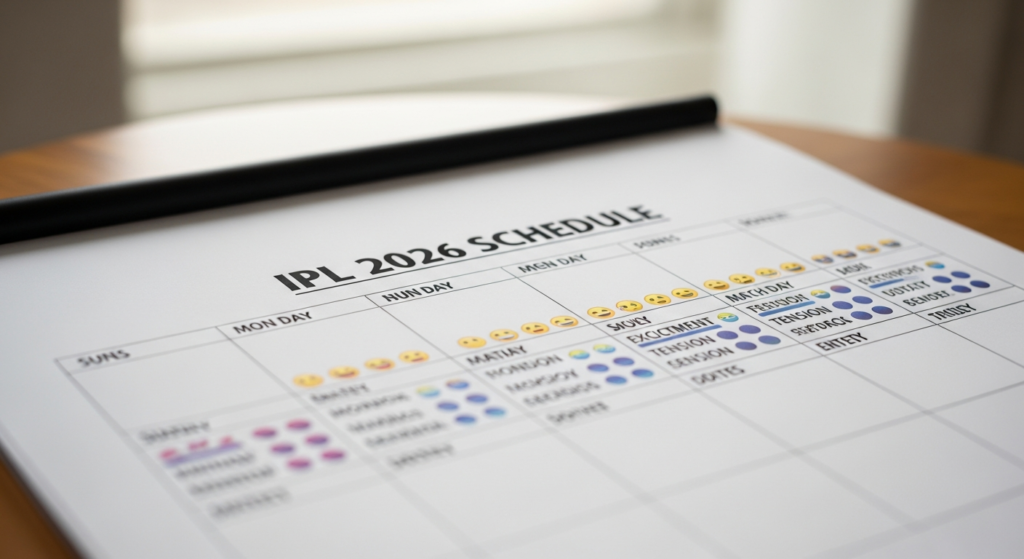
From 28 March, the league kicks off in Bengaluru, then hits Mumbai, Guwahati, New Chandigarh, Lucknow, Hyderabad, Ahmedabad, Delhi, Kolkata, Jaipur, Chennai, Dharamshala and Raipur in one long national tour. There are evening matches almost every day and double-headers on weekends when they throw in 3:30 PM games just to test if you actually care about your future.
Most polished articles will say: “The tournament will feature 74 matches across 13 venues.” Cool. Correct. Useless. What they don’t say is: your revision timetable dies the moment you realize your team has four games in 11 days, two of them finishing around midnight.
The schedule is built for broadcasters, stadiums, and advertisers first. You come somewhere after the power play. The league phase runs from late March through most of May, with the playoffs jammed into the final week, including Qualifier 1 in Dharamshala, Eliminator and Qualifier 2 in New Chandigarh, and the final at Narendra Modi Stadium in Ahmedabad on 31 May. Exams? Internal assessments? Sleep? Background characters.
Here’s what nobody actually says out loud:
The IPL 2026 schedule isn’t “busy”; it’s designed so that on most evenings, something important is always happening to some team you care about, directly or indirectly.
You think you’re safe because “my team isn’t playing today.” Then you see a match that might affect the points table, net run rate, or playoff race. Or you have that one friend who insists, “Bro, this SRH vs LSG game is actually huge for RCB.” And suddenly you’re deep into a Tuesday night thriller you had no intention of watching.
It gets worse around late April and May when the playoff race opens up. After a few teams mess up their mid-season stretch, scenarios start appearing like IIT coaching questions “If Team A wins by this margin and Team B loses two games but by less than X runs, then…” At that point, you’re not following the schedule, the schedule is dragging you around.
And let’s not ignore the geography flex. Matches in:
- Bengaluru (M. Chinnaswamy Stadium) – batting paradise.
- Mumbai (Wankhede) – evening dew and chasing drama.
- Guwahati, New Chandigarh, Dharamshala, Raipur – “secondary” venues that quietly ruin predictable patterns.
The real joke? You’ll see “From 28 March to 31 May” and think, oh, two months, chill. Then you look at the actual fixture grid on IPLT20 or ESPNcricinfo and realize there are almost no genuinely empty days. One random Thursday off, and suddenly that day becomes “catch up on highlights and points table scenarios” day.
So yeah, it’s not just a schedule. It’s a daily reminder that whoever planned this very much did not have your university timetable in mind.
HOW THIS ACTUALLY WORKS THE REAL MECHANICS
Let’s talk about how the IPL 2026 schedule is actually built, because once you understand the pattern, it stops feeling like chaos and starts feeling like a system you can play.
Officially, IPL 2026 is the 19th edition of the league, with 10 teams playing 74 matches from 28 March to 31 May. The league phase runs across roughly 52 days, followed by four playoff matches: Qualifier 1, Eliminator, Qualifier 2, and the final. On paper, it’s a simple “everyone plays 14 games” structure.
In practice, this means:
- Every team plays 14 league matches.
- They spread these across home and away venues, but “home” now includes second grounds like Guwahati for RR or Dharamshala for PBKS.
- Matches are mostly at 7:30 PM IST, with weekend double-headers adding 3:30 PM starts.
The league loves patterns:
- Season opener: usually a big-name clash 2026 kicks off on 28 March in Bengaluru, followed by a high-profile tie like Mumbai Indians vs Kolkata Knight Riders at Wankhede on 29 March.
- Early weeks: teams rotate through home games, and the schedule dips into new venues like New Chandigarh’s Maharaja Yadavindra Singh Stadium and Guwahati’s Barsapara Stadium.
- Mid-season: brutal travel plus back-to-back games, especially for teams like RR, PBKS, and LSG who shuttle between multiple “home” grounds.
- Final week of league phase: stacked with key fixtures that decide playoff spots.
This is where generic articles fall asleep: they list matches and never talk about what that schedule does to teams and fans.
Here’s the niche corner: the schedule creates “hidden pressure points” for both.
- Clusters of away games
When a team has three or four away matches in different cities in 10–12 days, it usually coincides with a dip or surge in form. You as a fan see “two losses in four days.” The schedule quietly says: “Bro, three flights, new pitches, new conditions.” - Afternoon matches for certain teams
Some teams get stuck with more 3:30 PM games in hot cities like Lucknow or Jaipur. That impacts bowling resources, energy, and even how captains use spinners and pacers. For fans, it means games clash directly with classes, coaching, or weekend outings. - Short turnarounds
You’ll find fixtures like “RCB play in Bengaluru on 18 April night, then travel and play again on the road within 2–3 days.” For viewers it feels like “oh, they play again already,” but for players, that affects rest and preparation. - Venue variety
Venues like Chinnaswamy (Bengaluru), Wankhede (Mumbai), Ekana (Lucknow), Chepauk (Chennai), New Chandigarh, Dharamshala and Raipur offer wildly different pitch behavior and boundary sizes. You’re not just tracking your team; you’re tracking your team plus how fast they adapt between conditions.
Short list, with honest opinions:
- Season opener week
Nice for hype, terrible if your internal tests are the same week. Every evening is “just one more over” territory. - Mid-April cluster
This is where the schedule starts punishing casual fans. Two matches a day, multiple cities, points table shifting every 24 hours. You blink, your team has played three games. - Final league week
Not just “who qualifies,” but “who avoids playing their playoff in a tough venue.” With Qualifier 1 in Dharamshala and the final in Ahmedabad, everyone is suddenly pretending they always cared about those grounds. - Playoff week
Four matches in six days, all high pressure, all at neutral-ish venues. Great TV, horrible for anyone with a morning exam.
Once you see these patterns, the schedule stops being a wall of dates and turns into a map you can plan around, even if that plan is basically: “accept that late April is gone.”
COMPARISON WHAT’S ACTUALLY DIFFERENT BETWEEN YOUR OPTIONS
When people say “IPL 2026 schedule,” they usually mean one of three things: league phase, playoffs, or “my team’s schedule only.” Let’s separate them before your brain melts.
| Option | What it actually does | Who it’s for | The catch |
|---|---|---|---|
| Full tournament schedule | Shows all 74 matches, all venues, all dates. | Hardcore fans, fantasy players, content creators | Overwhelming if you just want to know “when does my team play next” |
| Team-wise schedule | Only the 14 matches of your favorite team, with home/away split. | Fans loyal to one or two teams | You miss how other results affect the points table and playoff race |
| Playoff-only schedule | Just the last four games: Qualifier 1, Eliminator, Qualifier 2, Final. | Casuals who wake up when the trophy is near | You lose all the build-up and context that make those matches brutal |
My recommendation: use the full schedule once to mark key dates, then live in the team-wise view during the league phase and switch to tournament view in the last two weeks.
If you only watch playoffs, you technically “save time,” but you miss all the storylines that make those four matches hurt so much.
WHAT ACTUALLY HAPPENS WHEN YOU TRY THIS
When you actually try to keep up with the IPL 2026 schedule, not just casually glance at it, you realize how quickly cricket eats the calendar.
First, you open the official IPL site or ESPNcricinfo and scroll the fixtures: 28 March in Bengaluru, March 29 in Mumbai, March 30 in Guwahati, then games almost every day through April. At this stage, it still feels like a clean grid. You think, “I’ll just watch my team’s games.” Adorable.
Then you mark out your team’s 14 matches. You notice:
- Some home games on weekdays at 7:30 PM perfect procrastination slots.
- At least one or two 3:30 PM matches on weekends that clash directly with family plans or coaching.
- Back-to-back games where your team plays, then a rival plays next day in a match that affects the table.
What surprised me the first time I actually tracked a full IPL schedule was how little breathing space there is once you factor in everything: your team, rival teams, key standings clashes, and playoff scenarios. There are maybe 4–5 truly “free” evenings in the entire season if you’re even semi-serious.
There’s also a pattern nobody talks about: you get “schedule fatigue” before you get “cricket fatigue.” It’s not the sport that tires you, it’s the rhythm — every evening has a match, every weekend has two, and after a point your brain stops being able to tell Tuesday from Thursday. Only “that day DC choked a chase” and “that Sunday MI pulled off a miracle.”
usually end up in one of these modes:
- Hyper-fan: You try to follow almost every match for the first two weeks. By mid-April, you’re exhausted but too invested to stop.
- Team-loyal: You only watch your team’s games, then end up sneaking in extra matches once the playoff race gets spicy.
- Highlights-only (fake control): You say you’ll just watch highlights the next morning, but when a chase looks tight, you cave and open the stream in the 17th over anyway.
Something most articles miss: the schedule shapes online conversations too. When there’s a gap day or a lighter fixture, people suddenly have energy for debates — “all-time IPL XI,” “orange cap predictions,” “who should retire.” But in heavy weeks with double-headers and tight finishes, the entire timeline is just live reactions and memes. The schedule literally changes your social feed.
So when you commit to “following IPL 2026,” you’re accidentally committing to a very specific lifestyle for two months: evenings mapped to fixtures, weekends mapped to double-headers, and your brain permanently half-aware of what’s happening in Ahmedabad or Lucknow whether you like it or not.
THE ADVICE EVERYONE GIVES VS WHAT ACTUALLY WORKS
Let’s drag some common “schedule advice” you hear every season.
- “Just download the full schedule PDF and you’re sorted.”
Yes, the official schedule PDF from IPLT20 is clean and accurate, and telecom partners and blogs mirror it nicely. But a static PDF doesn’t help when you need reminders, conflicts, or context. You’ll save it once and never open it again.
What actually works: use the PDF once as your base, then plug the key fixtures especially your team’s games and the playoff week into your calendar app with alerts. That’s how you stop “oh wait, they were playing today?” disasters. - “Watch every match, that’s how you really enjoy IPL.”
This sounds romantic, but real life exists. Two months, almost daily games, double-headers on weekends you cannot realistically watch every match and also stay functional as a student or someone doing anything productive.
What actually works: choose tiers. Tier 1: non-negotiable matches (your team vs big rivals, playoff deciders). Tier 2: important neutral games (points table impact). Tier 3: background matches you follow by live score while doing other stuff. You don’t respect cricket less by not watching every ball. You respect your sleep more. - “Focus only on your team’s schedule, other matches don’t matter.”
This works for the first half of the league at best. Once mid-table chaos begins, other matches can decide whether your team can even qualify, or whether you need unrealistic equations like “they must win by 63 runs.”
What actually works: track your team’s fixtures closely, but also mark 1–2 key games every week that involve direct rivals. That way, when you check the table, you actually understand how it got there. - “You’ll catch up during playoffs if you’re busy now.”
Sure, you can only watch the last four matches, but then you’re watching them like random blockbusters with no backstory. You won’t know why some players look burnt out or why one team is bizarrely obsessed with chasing.
What actually works: even in your busiest weeks, at least track results and short highlights of your team’s fixtures and big upsets. That 10-15 minutes keeps the narrative alive without hijacking your schedule.
This whole “all or nothing” mindset around the IPL schedule is the problem. You’re allowed to follow it in a way that respects your actual life, not just your FOMO.
THE PRACTICAL PART WHAT TO ACTUALLY DO
Let’s turn schedule chaos into something you can control.
- Build a personal “must-watch” list
Open the full IPL 2026 fixture list on IPLT20, ESPNcricinfo, Olympics.com, or a reliable telecom blog. Mark all matches involving your favorite team and 4–5 neutral blockbusters (like MI vs CSK, RCB vs KKR, GT vs CSK, etc.). These become your priority matches. If life hits, you drop everything else, not these. - Block playoff week right now
You already know the playoffs will run in the last week of May, with Qualifier 1, Eliminator, Qualifier 2, and the final set at Dharamshala, New Chandigarh, and Ahmedabad. Put soft blocks on those evenings in your head and calendar. Don’t agree to random outings during the final unless you truly don’t care about cricket. - Pair matches with tasks instead of pretending you’ll “ignore IPL”
On heavy schedule weeks when the league is churning out matches daily across multiple venues accept that you’ll follow at least some of them. Watch league-stage games while doing lighter tasks: notes revision, cleanup, or basic project work. Save “no match” nights (rare, but they exist) for actual deep focus. - Learn your team’s travel pattern
Use any good schedule page that shows venues clearly, like Cricbuzz, Vi, or Tata Play. Notice stretches where your team is on the road or playing in tougher venues like Chepauk, Ekana, or Dharamshala. Set your expectations and trash talk accordingly. - Decide your “no-screen overs” in advance
If exams are close, pick overs or days you will deliberately skip: maybe afternoon games, or matches involving bottom-table teams. The schedule is long enough that you can miss some chunks and still feel plugged in. That’s how you stop resenting cricket for “ruining” your time. - Use schedule plus points table together
Checking the fixture list without the points table is like seeing exam dates without knowing pass marks. Use ESPNcricinfo or IPLT20 schedule alongside live standings to see which upcoming fixtures actually matter. This helps you prioritize critical games and skip dead rubbers guilt-free. - Share the schedule with your people
If your friends or family also watch IPL, send them your “must-watch” list so plans don’t collide. It sounds silly, but once they know “hey, May 31 evening is sacred,” you avoid last-minute reload fights over the remote before the final.
QUESTIONS PEOPLE ACTUALLY ASK
What is the full IPL 2026 schedule?
IPL 2026 runs from 28 March to 31 May, with 10 teams playing 74 matches across 13 venues in India. The league stage covers most of April and May with near-daily matches, including weekend double-headers. The official IPL website and major cricket portals like ESPNcricinfo, Olympics.com, and partner sites host the complete, updated match list. Always double-check there if you see a random WhatsApp “schedule” graphic floating around.
When does IPL 2026 start and end?
The 2026 Indian Premier League season starts on 28 March and is scheduled to end with the final on 31 May. That gives you roughly 65 days of cricket, spread across the league phase and four playoff matches. The exact dates and timings are confirmed through the official schedule PDF and fixture sections on IPLT20 and broadcast partner pages. So yes, it fully overlaps with the usual exam and college chaos season.
How many matches are there in IPL 2026?
There are 74 matches in IPL 2026. Each of the 10 teams plays 14 league games, followed by four playoff matches Qualifier 1, Eliminator, Qualifier 2, and the final. The structure is similar to recent seasons: lots of league fixtures, then a short, intense knockout phase. For fans, it means you almost always have a game on in the evening.
Which venues are hosting IPL 2026 matches?
Matches are being played across 13 venues, including M. Chinnaswamy Stadium (Bengaluru), Wankhede Stadium (Mumbai), ACA Stadium (Guwahati), Maharaja Yadavindra Singh Stadium in New Chandigarh, Ekana Stadium (Lucknow), MA Chidambaram Stadium (Chennai), Arun Jaitley Stadium (Delhi), Narendra Modi Stadium (Ahmedabad), Eden Gardens (Kolkata), Sawai Mansingh/Jaipur, HPCA Stadium (Dharamshala), a venue in Raipur, and more. Different teams have different “home” and “second home” grounds among these. This variety is exactly why conditions change so much from match to match.
Where can I download the official IPL 2026 schedule PDF?
You can download the official schedule PDF directly from IPLT20’s documents section, where they publish files like “TATA IPL 2026 Schedule.” This includes match numbers, dates, start times, teams, and venues in one place. Some DTH and telecom partners like Tata Play and Vi also mirror the schedule in blog or table form, but the IPL site remains the primary, most trustworthy source. If the PDF and a random Instagram graphic disagree, trust the PDF.
Where will the IPL 2026 final be played?
The IPL 2026 final is scheduled at Narendra Modi Stadium in Ahmedabad on 31 May, which will be hosting its fourth IPL final after 2022, 2023, and 2025. The playoff week also features Qualifier 1 at Dharamshala’s HPCA Stadium and the Eliminator and Qualifier 2 at New Chandigarh’s Maharaja Yadavindra Singh Stadium. So the last stretch of the tournament is heavily focused on north and west India venues.
How do I find only my team’s IPL 2026 matches?
Most major cricket websites and apps let you filter IPL 2026 fixtures by team. On the official IPL site or ESPNcricinfo, go to the series page and use filters to show, for example, only “Mumbai Indians” or “RCB” matches. Some telecom/blog sites also publish team-wise schedules in separate sections. This is the easiest way to build your personal watchlist without staring at 74 lines of fixtures.
Are there many afternoon matches in IPL 2026?
Yes, like recent seasons, IPL 2026 has a bunch of 3:30 PM IST matches, mostly on weekends and double-header days. These afternoon games often happen in venues like Kolkata, Lucknow, New Chandigarh, and others depending on the day. They’re great if you’re home, but brutal if you have classes, coaching, or travel. So check the schedule for early starts, not just 7:30 PM games.
Has the IPL 2026 schedule changed at any point?
The official schedule always includes a disclaimer that fixtures may be subject to change if required. Typically, the main grid published in March sticks, but small tweaks can happen due to logistics, weather, or other events. The safest approach is to rely on IPLT20 and major cricket portals like ESPNcricinfo or Olympics.com for final confirmation, especially for matches later in the season and the exact playoff timing.
SO WHERE DOES THIS LEAVE YOU?
So where does IPL 2026 schedule leave you? Somewhere between “this is the best two months of the year” and “who scheduled my exam on the same day as a knockout game.”
The reality is simple: from 28 March to 31 May, evenings in India are basically booked. There are 74 matches, 13 venues, and only a handful of quiet days. You’re not supposed to watch everything. You’re supposed to choose where you plug in and where you let the season just pass in the background.
One concrete thing you can do today: pick your team, open a proper fixture page, and mark their 14 league matches plus playoff week on your calendar with real reminders. Not in your head. Not “I’ll remember.” Actual alerts. Then give yourself permission to treat the rest of the schedule like optional side quests.
It’s not perfect. You’ll still get pulled into random thrillers and late finishes. But at least this way, you’re choosing when the schedule runs your life, instead of pretending it doesn’t and losing that argument every single evening.
CONCLUSION
If you’re still here, you didn’t come for just dates and venues. You came because you know this schedule decides what your next two months feel like.
Now you know the structure, the cities, the crunch weeks, the playoff roadmap not just “who plays when,” but how that hits your time, your sleep, and your FOMO. You don’t have to obey every match; you just have to be honest about which ones you care about and plan around those.
The line to remember is this: the IPL 2026 schedule is fixed, but how much of your life it owns is not. Decide your must-watch list before the season decides it for you.
Now, be honest are you going to actually put those matches in your calendar, or are you going to trust your memory and blame “unexpected fixtures” later?
Meta description:
IPL 2026 schedule is chaos on a calendar. Here’s the no nonsense guide to who plays when, where and why your semester doesn’t stand a chance.