When will the drawing start, and how long will it take?
Dan Roan reports from Washington before the 2026 World Cup draw
The ceremony starts at 17:00 GMT (12:00 local time) on 5 December, but there’s far more to this glitzy event than simply pulling the countries out of a hat.
Supermodel Heidi Klum, comedian Kevin Hart and actor and producer Danny Ramirez will co-host.
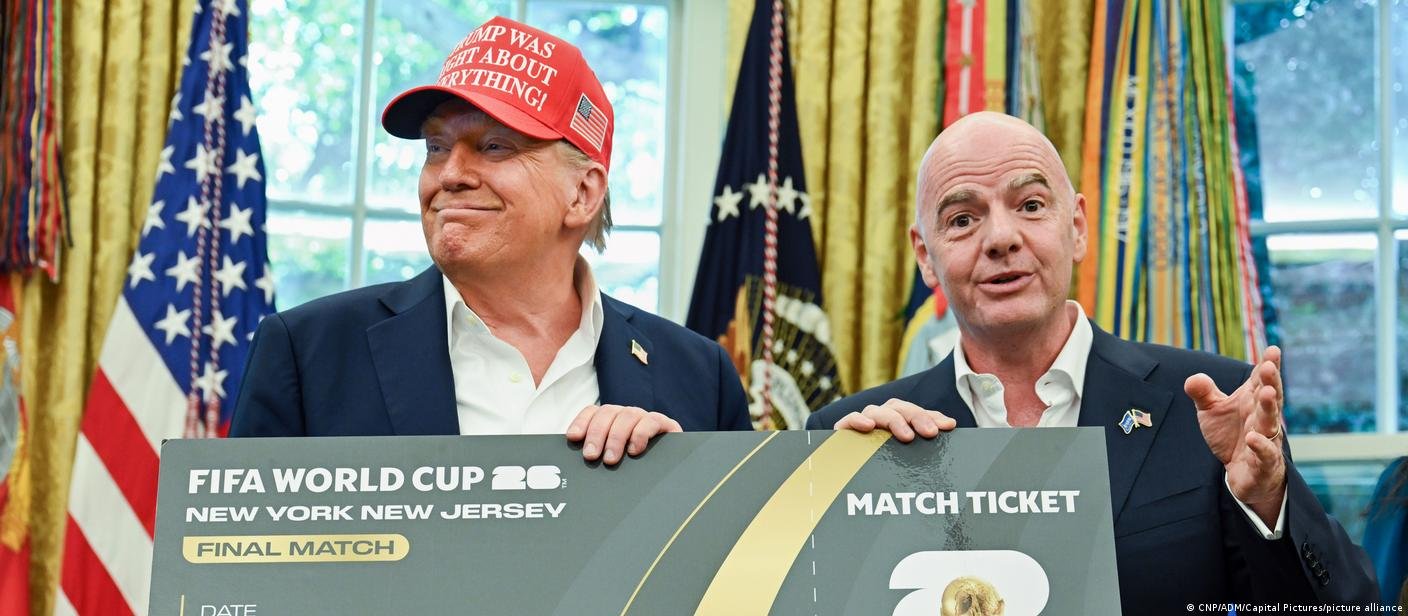
Before the draw, there will be live music performances from Andrea Bocelli, Robbie Williams and Nicole Scherzinger. At the same time, FIFA president Gianni Infantino and US President Donald Trump are both expected to make speeches.
Then it is on to video clips of the finalists, introductions and the draw itself.
Former Manchester United and England defender Rio Ferdinand will conduct the draw.
The 47-year-old will be joined by broadcaster Samantha Johnson and a host of sporting greats, including Tom Brady, Wayne Gretzky, Aaron Judge and Shaquille O’Neal.
Once the draw has been completed, the Village People will perform YMCA to bring the ceremony to a close, with the entire ceremony expected to last about 90 minutes.
How has FIFA seeded the draw?
The 48 teams have been placed into four pots of 12, primarily based on FIFA World Rankings.
The exceptions are the three hosts who are automatically in pot one, and the teams who will qualify through the six play-off paths, who go into pot four.
Given the teams involved in the four European play-off paths, they could create some strong groups.
Italy and Denmark would have been in pot two because of their world rankings had they qualified directly, while Wales would have been in pot three.
The six play-off paths are:
UEFA Play-off A: Italy, Wales, Bosnia-Herzegovina, Northern Ireland
Uefa Play-off B: Ukraine, Poland, Albania, Sweden
UEFA Play-off C: Turkey, Slovakia, Kosovo, Romania
UEFA Play-off D: Denmark, Czech Republic, Republic of Ireland, North Macedonia
Fifa Play-off 1: DR Congo, Jamaica, New Caledonia
Fifa Play-off 2: Iraq, Bolivia, Suriname
How will the draw work?
The 12 groups will include one team from each of the four pots.
FIFA will start by drawing the teams from Pot One.
Co-hosts Mexico (A1), Canada (B1) and the United States (D1) will have coloured balls with their flags on to denote their special status. Their group positions are predetermined to ensure they play all their games in their own countries.
The draw will then continue with pots two, three and four in order.
What is this about the top four teams being kept apart?
FIFA’s big idea is to set up the best chance of blockbuster ties in the latter stages of the World Cup.
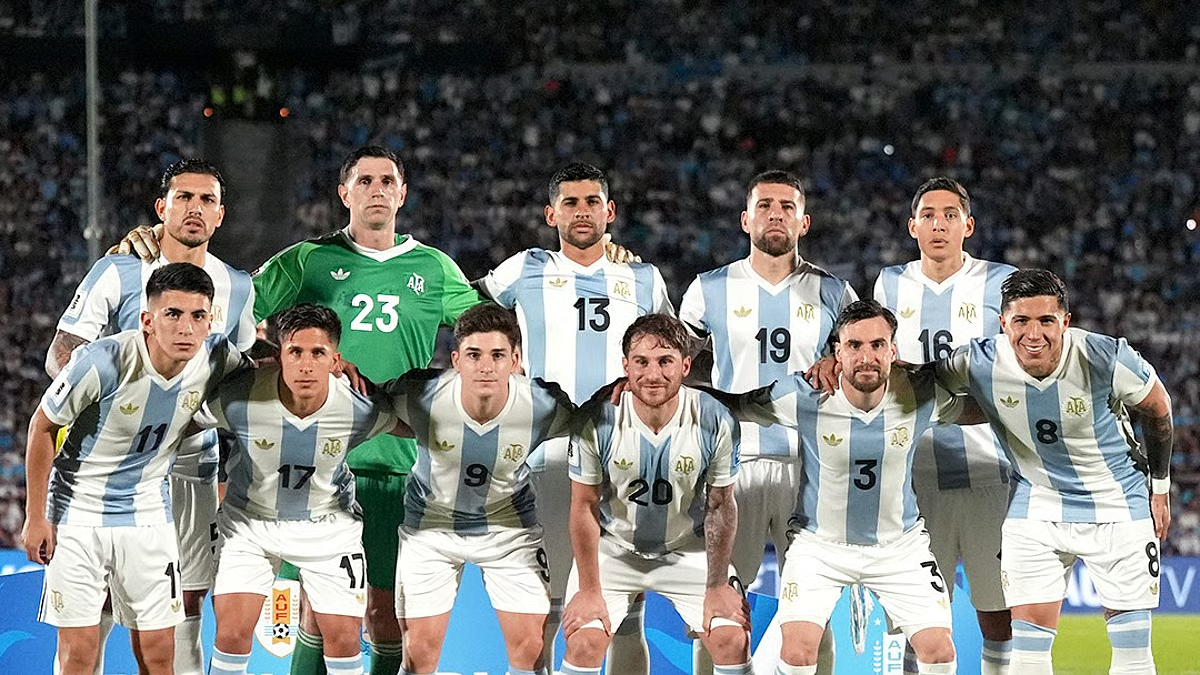
So for the first time, it is giving special seeding status to the top four in the world rankings – Spain, Argentina, France and England.
Crucially, this status will only apply if the countries win their groups.
Let’s take a look at how it will work, using England as our example.
Each of the four countries will be drawn into a group in a different
Spain (ranked 1) and Argentina (2) must be in opposite halves and cannot meet until the final, likewise France (3) and England (4).
France and England would not meet either Spain or Argentina until the semi-finals.
Let’s say that France comes out first and goes into Group C, placing them into the green quadrant on the right side of the draw. That means England can only go into the blue or turquoise quadrants on the left side, groups E, F, G, H or I.
If Argentina then drop into the blue quadrant, that further restricts England only to turquoise – groups G or H.
Are the four seeds being given an easy ride? Not necessarily.
Each quadrant has a potential last-16 tie between two group winners. For instance, the blue quadrant hosts the winners of Group E and Group I. That means a seeded team could meet another pot one side, let’s say, Brazil.
Being drawn into groups C, F, H, or J is more favourable, as it is not possible to play another group winner until the quarter-finals.
If one of the four seeded teams finishes as group runners-up, then they lose the ranking privilege.
If England were to finish second in Group H, they would move out of turquoise and into red – perhaps meeting Spain, Argentina or France as the winners of Group J in the first knockout round.
If Spain, Argentina, France and England win their groups, they will be placed in separate quadrants for the knockout bracket.
What are the draw restrictions to watch out for?
There can be no more than one team from the same confederation per group. So, for instance, Brazil and Uruguay (Conmebol) cannot be in the same group, nor can Panama and the United States (Concacaf).
There is an exception for UEFA because there are 16 teams and only 12 groups. That means four groups will contain two European nations.
It all seems relatively straightforward, but as we go, these constraints will cause serious complications as countries skip groups to avoid clashes with teams from their own confederation.
That means it will not just be a case of teams slotting into Group A, then Group B, then Group C, in the order they are drawn.
When we get to pots three and four, it might seem like countries are being sent to random groups.
FIFA needs to prevent deadlocking, which occurs when it is no longer possible to complete the draw while following the regulations.
The primary issue is the teams that can qualify via the inter-confederation play-off pathways and will go into pot four.
Pathway 1 has New Caledonia (OFC), Jamaica (Concacaf) and DR Congo (CAF)
Pathway 2 has Bolivia (Conmebol), Suriname (Concacaf) and Iraq (AFC)
Both paths have a Concacaf team, so they are automatically blocked out of four groups (those containing the United States, Mexico, Canada and Panama).
The first pathway is less of a problem, because the only other Oceania team, New Zealand, are also in pot four.
But the second pathway complicates things because there are 17 deadlocking nations across pots 1, 2, and 3. So, the only way to complete the draw is for the team that qualifies via this route to be placed in a group with two European countries and an African nation.
What will this look like in practice?
When pot two is being drawn, the computer must ensure that at least one group has two European teams, or one European and one African team.
When it comes to pot three, there will then be two possible draw routes.
If there is one group with two European nations, then Egypt, Algeria, Tunisia, or the Ivory Coast must join it.
If there is one group with an African and European nation in it, then Norway or Scotland must go into it.
Both could happen, in which case the draw computer will ensure one is filled as necessary.
If we get to pot four and there is only one group which meets this criterion, pathway two will have to go into it.
The other pot-four teams – the four potential play-off winners from UEFA, two from Concacaf, two African and one Asian nation – will have their own deadlock restrictions.
The UEFA play-off paths, which include Wales, Northern Ireland and the Republic of Ireland, will have limited options because 12 European teams will already have been drawn.
It might be hard to keep up at this point.
How will teams be allocated to their groups?
Once a team has been drawn, it will be placed in the first available group, in alphabetical order, adhering to the draw constraints.
The draw computer will ensure Spain, Argentina, France and England are placed in groups in the correct quadrant of the bracket.
To speed up the process, countries will not be assigned to their specific group positions to determine the fixture order.
Seeded countries will all go into position 1, with a predetermined grid for the other pots.
For instance, let’s take Scotland in pot three. The yellow box will determine their fixture order.
If they are drawn first from pot three, they will go into Group A with Mexico.
The grid shows that the team from pot three will go into position two.
The first match is A1 v A2, so that Mexico would play Scotland in the opening game of the World Cup.
The group position by pot has been pre-determined and will not be decided by a draw.
When will teams find out when and where they will play?
While nations will know their opponents and match dates on Friday, 5 December, they will have to wait 24 hours to find out venues and kick-off times.
The exceptions are groups A (Mexico), B (Canada), and D (US), which include the three host nations and already have venues for the fixtures, but not the kick-off times.
For all other groups, you’ll know only the date and the order of matches when FIFA unveils the match schedule in a live broadcast on Saturday, 6 December at 17:00 GMT (12:00 local time).
FIFA president Gianni Infantino will be joined on stage by legends of the game to discuss the key matches.
All 12 groups will play fixtures in this order:
• Match Day 1: 1 v 2, 3 v 4
• Match Day 2: 1 v 3, 4 v 2
• Match Day 3: 4 v 1, 2 v 3
For More Sport Information Click Here