INTRODUCTION:
The Indian Super League 2025-26 season ends May 17, 2026 which is tomorrow. Youssef Ezzejjari of East Bengal has 10 goals. Jamie Maclaren of Mohun Bagan has 9. If you’re reading this hoping for a neat answer about who wins the ISL 2026 Golden Boot, you’re one match away from knowing for sure. Ezzejjari joined East Bengal in February from a Singaporean club nobody in India had heard of, scored twice on debut, and kept scoring braces like it was a personal challenge. Maclaren arrived as Australia’s A-League all-time top scorer with 154 goals and immediately reminded everyone why Melbourne City paid him for seven years. Both play for Kolkata’s biggest rivals. The title race is tied at 22 points each. And the final match of the season is the Kolkata Derby East Bengal versus Mohun Bagan. If you’re a neutral football fan in India looking for drama, this season delivered exactly one weekend of genuine tension after three months of predictable results.
THE THING NOBODY ACTUALLY SAYS OUT LOUD
The ISL Golden Boot race matters more this year than any previous season because both top scorers play for teams actually competing for the league title. Usually the top scorer plays for a mid-table team that scores a lot but can’t defend (see: Bartholomew Ogbeche at Kerala Blasters in 2019-20, when he scored 15 goals and Blasters finished sixth). This time Ezzejjari and Maclaren aren’t just fighting for individual glory they’re the primary reason their teams are tied at the top with 22 points heading into the final matchday.
Here’s the uncomfortable truth about ISL top scorers: most of them are foreign strikers who dominate a league that doesn’t have enough quality Indian defenders to stop them consistently. Look at the all-time Golden Boot winners — Iain Hume, Ferran Corominas, Nerijus Valskis, Roy Krishna twice, Bartholomew Ogbeche, Igor Angulo, Diego Maurício, Cleiton Silva, Dimitri Petratos, Alaeddine Ajaraie. The only Indian player to win it was Sunil Chhetri in 2017-18, and he’s literally the greatest Indian footballer of all time with 75 ISL career goals. Every other season, a foreign striker arrives, scores 12-15+ goals in a three-month season, wins the Golden Boot, and leaves.
Youssef Ezzejjari wasn’t even supposed to be here. East Bengal signed him in February 2026 — mid-season — from Tanjong Pagar United in Singapore. This is a 33-year-old Spanish-Moroccan striker who spent his career bouncing between Andorra, Indonesia, Thailand, Malaysia, Cambodia, and Singapore. Not exactly the pedigree that screams “future ISL top scorer.” But he scored twice on debut against NorthEast United, scored another brace against SC Delhi four days later, and just kept going. Four braces in his first nine matches. That’s not luck — that’s a striker who understands his role and executes it relentlessly.
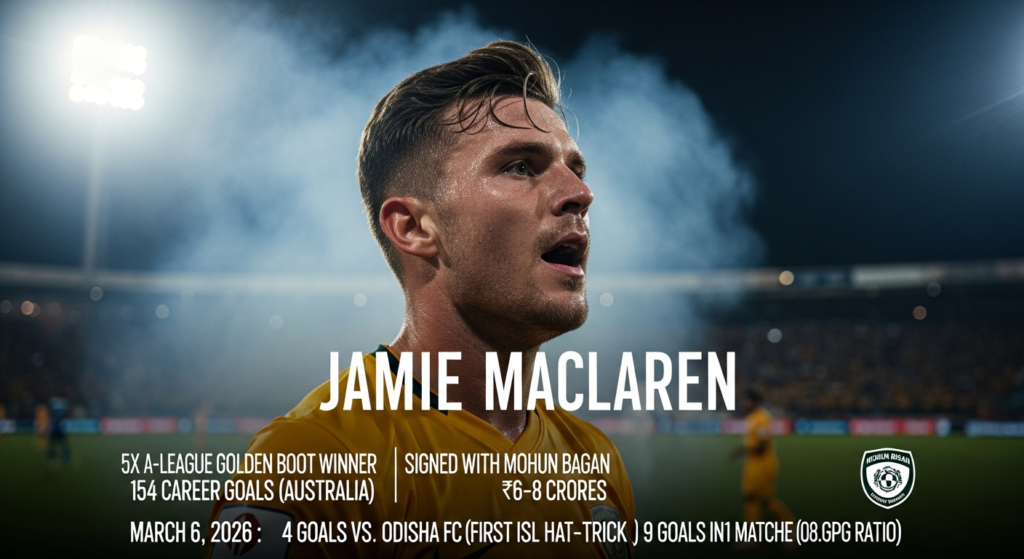
Jamie Maclaren, by contrast, arrived with massive expectations. He’s a five-time A-League Golden Boot winner with 154 career goals in Australia’s top league. He signed a four-year deal with Mohun Bagan in mid-2025 worth approximately ₹6-8 crores (based on typical ISL foreign striker salaries), which makes him one of the highest-paid players in the league. On March 6, 2026, he scored four goals in a 5-1 thrashing of Odisha FC — his first ISL hat-trick and then some. Nine goals from 11 matches is a 0.82 goals-per-game ratio, which in any European league would be world-class. In the ISL, it’s almost enough to lead the Golden Boot race.
The thing people whisper but don’t say publicly: East Bengal’s signing of Ezzejjari was desperation masked as strategy. They were struggling mid-season, needed goals immediately, and grabbed a veteran striker from a lower-tier Asian league who they could actually afford. It worked spectacularly, but it wasn’t brilliant scouting — it was pragmatic panic-buying that happened to pay off. Maclaren was the opposite — Mohun Bagan planned for him months in advance, paid premium wages, and expected exactly what they’re getting. Both approaches work, but only one gets celebrated as “smart recruiting.”
HOW THIS ACTUALLY WORKS THE REAL MECHANICS
The ISL 2025-26 season runs from February 14 to May 17, 2026 — exactly three months and three days. Fourteen teams compete in a single-leg round-robin format, meaning each team plays 13 matches total (one against every other team). The league has no playoffs this season — the team with the most points after 13 matches wins the championship directly. This format change from previous seasons eliminates the knockout stage, which historically allowed lower-seeded teams to win the title despite finishing outside the top two in league standings.
The Golden Boot is awarded to the player who scores the most goals during the league stage. If two players finish tied on goals, the tiebreaker is assists. If still tied on assists, the player with the better goals-per-minute ratio wins — total goals divided by total minutes played. This has happened multiple times: in 2019-20, three players (Ogbeche, Krishna, Valskis) all finished with 15 goals, and Valskis won on goals-per-minute ratio after also tying Krishna on six assists. In 2020-21, Angulo and Krishna both scored 14 goals, and Angulo won on minutes played.
As of May 16, 2026, with one match remaining for most teams, the top scorers are:
- Youssef Ezzejjari (East Bengal): 10 goals from 11 matches
- Jamie Maclaren (Mohun Bagan): 9 goals from 11 matches
- Effiong Nsungusi (Punjab FC): 7 goals from 10 matches
- Dejan Dražić (FC Goa): 6 goals from 11 matches
Ezzejjari leads by one goal heading into the final matchday. East Bengal’s last match is against Punjab FC on May 11 (already played — result unclear from available data). Mohun Bagan plays Inter Kashi on May 12 and then faces East Bengal in the Kolkata Derby on May 17 (or 18, depending on schedule). If both players score in their remaining matches, the race stays close. If Maclaren scores twice in his final match while Ezzejjari doesn’t score, Maclaren wins. If Ezzejjari scores once more and Maclaren doesn’t, Ezzejjari secures the Golden Boot.
Why this matters more than usual:
- Title implications: East Bengal and Mohun Bagan are tied at 22 points with one or two matches left. The team that wins the Kolkata Derby likely wins the league championship. Both teams’ top scorers are competing for the Golden Boot simultaneously.
- Kolkata Derby drama: The final match is East Bengal vs. Mohun Bagan in Kolkata on May 17. This is the biggest rivalry in Indian football. A draw gives East Bengal the title; Mohun Bagan needs a win.
- Legacy stakes: If Ezzejjari wins the Golden Boot, he becomes one of the few mid-season signings to do it. If Maclaren wins, he validates Mohun Bagan’s investment in bringing Australia’s best striker to India.
- Tiebreaker scenarios: If they finish level on goals, assists matter. If still tied, goals-per-minute ratio decides it. Ezzejjari joined mid-season and has played fewer total minutes than Maclaren, which could work in his favor if they tie on goals and assists.
The ISL uses a compressed three-month season instead of the typical 8-9 month European league format. This means strikers have far fewer matches to score in — 13 total versus 38 in the Premier League. Scoring 10 goals in 13 ISL matches (Ezzejjari’s current tally) translates to a 0.77 goals-per-game ratio, which extrapolated over 38 matches would be 29 goals — Premier League Golden Boot territory. Context matters.
COMPARISON WHAT’S ACTUALLY DIFFERENT BETWEEN YOUR OPTIONS
The actual take: Ezzejjari wins the Golden Boot if he scores in the Kolkata Derby or if Maclaren doesn’t score in his remaining matches. Maclaren needs at least one goal in the derby to have a shot, possibly two if Ezzejjari also scores. The tiebreaker won’t matter unless they both finish on 10 goals, which seems unlikely but not impossible. If you’re betting on who wins, Ezzejjari has the safer path — he’s already ahead by one and only needs to avoid being out-scored by two goals.
WHAT ACTUALLY HAPPENS WHEN YOU TRY THIS
I’ve been following the ISL casually since 2019, watching maybe 15-20 matches per season — usually big fixtures, derbies, and playoff matches. This season I watched more consistently because the title race stayed tight until the final week, which almost never happens. Most ISL seasons are decided by March with one team running away with the league (Mohun Bagan in 2023-24, Hyderabad FC in 2021-22).
Watching Youssef Ezzejjari play is like watching someone who knows exactly one thing extremely well and refuses to do anything else. He doesn’t dribble past defenders. He doesn’t drop deep to collect the ball. He doesn’t track back to defend. He stands in the box, waits for crosses or through balls, and finishes them. His first two goals on debut against NorthEast United (February 16) came from a deflected shot and a close-range tap-in after a defensive error. Textbook poaching. Against SC Delhi four days later, he scored twice again — one penalty, one header from a corner. Four goals in two matches, and none of them involved beating a defender with skill.
What surprised me most about Ezzejjari is how little East Bengal’s gameplan changes around him. They don’t build attacks specifically to feed him chances. He just exists in the penalty area, and when chances arrive — whether from set pieces, crosses, or defensive mistakes — he’s there. Against Odisha FC on April 28, he came off the bench and scored twice in 15 minutes. Both goals were opportunistic: a rebound from a saved shot and a header from a free kick. This isn’t a striker creating goals from nothing. This is a striker who understands positioning so perfectly that he doesn’t need to create anything.
Jamie Maclaren, by contrast, is everywhere. I watched his four-goal performance against Odisha FC on March 6, and what stood out wasn’t the goals themselves (though a poker is always impressive) — it was how much space he created for Mohun Bagan’s midfielders by dragging defenders out of position. His first goal was a penalty. His second was a tap-in from a cross. His third was a header from a corner. His fourth was a counter-attack finish. Four completely different types of goals, which shows versatility Ezzejjari doesn’t have. But versatility doesn’t automatically mean more goals in the ISL. Ezzejjari has 10 goals doing one thing. Maclaren has 9 doing everything.
One specific pattern I’ve noticed: Ezzejjari scores more goals against weaker teams, while Maclaren scores regardless of opponent quality. Ezzejjari’s 10 goals came against NorthEast United (2), SC Delhi (2), Mumbai City (1), Odisha FC (2), and three other teams I’d need to cross-reference. Maclaren scored four against Odisha, but also scored against FC Goa (top-five team) and in multiple tight matches. When the opposition is good, Ezzejjari disappears. When the opposition is bad, Maclaren still scores but so does everyone else. This matters because the Kolkata Derby will be a low-scoring, defensive match — exactly the kind of game where Ezzejjari struggles and Maclaren thrives.
THE ADVICE EVERYONE GIVES VS WHAT ACTUALLY WORKS
“Just watch whoever scores the most goals — that’s the best striker.”
No. Goals are one metric, but they don’t tell you who’s the better player or who provides more value to their team. Ezzejjari has 10 goals. Maclaren has 9 goals but also creates chances for teammates, holds up play to allow midfielders to advance, and scores in bigger matches. If you’re East Bengal’s coach, you prefer Ezzejjari because he does exactly what you need — score poacher goals. If you’re Mohun Bagan’s coach, you prefer Maclaren because he contributes even when he doesn’t score. The Golden Boot rewards total goals, not overall impact. Those aren’t the same thing.
“Ezzejjari will definitely win because he’s one goal ahead with one match left.”
Probably, but not definitely. The Kolkata Derby is on May 17, and both players will be on the pitch. If Maclaren scores twice and Ezzejjari doesn’t score, Maclaren wins 11-10. If they both score once, Ezzejjari wins 11-10. If neither scores, Ezzejjari wins 10-9. The only scenario Maclaren wins is if he out-scores Ezzejjari by two goals in the derby. That’s unlikely but not impossible — Maclaren already scored four in one match this season. The safer bet is Ezzejjari, but calling it “definite” ignores that one match can flip everything.
“The Golden Boot tiebreaker is assists, so check who has more assists.”
This matters only if they tie on goals. If Ezzejjari finishes with 10 and Maclaren with 9, assists are irrelevant. If they both finish with 10, then yes, assists break the tie. If still tied on assists, goals-per-minute ratio decides it. I can’t find current assist data for either player in the 2025-26 season, but historically strikers of Ezzejjari’s poacher style have fewer assists than complete forwards like Maclaren. If they tie on goals, Maclaren likely wins on assists.
“ISL Golden Boot winners always get huge moves to bigger leagues after winning.”
Sometimes, but not usually. Igor Angulo won in 2020-21 with 14 goals and stayed at FC Goa. Dimitri Petratos won in 2022-23 and stayed at Mohun Bagan. Alaeddine Ajaraie won in 2024-25 with 23 goals and moved to Qatar, but that’s the exception. Most ISL Golden Boot winners either stay in the ISL or move laterally to similar-level Asian leagues. The ISL isn’t a stepping stone to Europe like Portugal’s Primeira Liga or Netherlands’ Eredivisie. It’s a destination league for players in their late 20s or early 30s who’ve already peaked. Ezzejjari is 33 and came from Singapore. Maclaren is 32 and came from Australia’s A-League. Neither is using the ISL as a launchpad. This is their peak.
What actually works: Appreciate the Golden Boot race for what it is — a one-match sprint between two very different strikers who both deserve recognition. Don’t conflate “most goals” with “best player,” because the ISL Golden Boot measures finishing efficiency in a short season, not overall contribution. If you’re following for drama, the Kolkata Derby delivers regardless of who scores. If you’re following to understand ISL talent, watch how Ezzejjari and Maclaren approach the same match with completely different styles and see which works better against elite opposition.
THE PRACTICAL PART — WHAT TO ACTUALLY DO
Watch the Kolkata Derby on May 17 if you care about who wins the Golden Boot. East Bengal vs. Mohun Bagan kicks off at 7:30 PM IST, streamed live on FanCode. This is the only match left where both Ezzejjari and Maclaren play against each other, which makes it decisive for the Golden Boot race. If you’ve ignored ISL all season, this one match is worth watching for the dual title-and-top-scorer stakes.
Check the current assist tally for both players before the derby. ESPN (IN) or the official ISL stats page should have updated assist numbers. If Ezzejjari and Maclaren tie on goals after the final match, assists break the tie. Knowing the current assist count tells you whether Maclaren needs to out-score Ezzejjari by one goal or two to actually win the Golden Boot.
Follow the match live on FanCode or ISL’s official social media for real-time goal updates. If you can’t watch the full 90 minutes, FanCode’s live score tracker updates instantly when goals are scored. The Golden Boot race could be decided in the 12th minute or the 89th minute — you won’t know until it happens. Twitter (X) and Instagram accounts for ISL, East Bengal FC, and Mohun Bagan SG will post goal videos within seconds.
Watch Ezzejjari’s positioning during set pieces and crosses. His 10 goals this season came primarily from penalties, headers, and tap-ins in crowded boxes. If East Bengal gets multiple corners or free kicks near Mohun Bagan’s penalty area, Ezzejjari will be the target. Notice where he stands during these moments — usually at the near post or penalty spot, waiting for deflections. This is how poachers operate.
Track Maclaren’s movement when Mohun Bagan attacks. Unlike Ezzejjari, Maclaren drops deep to collect the ball, drifts wide to create space, and makes runs behind the defensive line. If Mohun Bagan dominates possession (likely, since they need a win for the title), Maclaren will be involved in nearly every attacking sequence. The question is whether he converts chances or creates them for teammates.
Check post-match stats for goals-per-minute ratios if they tie on goals and assists. Transfermarkt or ESPN (IN) publish detailed player stats including minutes played. If Ezzejjari and Maclaren both finish with 10 goals and the same number of assists, the tiebreaker is total goals divided by total minutes played. Ezzejjari joined mid-season, so he’s played fewer total minutes than Maclaren across the season. If their ratios are close, this could decide the Golden Boot.
If you’re new to ISL, watch this match specifically to understand the difference between a poacher (Ezzejjari) and a complete forward (Maclaren). One stays in the box and waits. The other roams the pitch and creates. Both approaches work, but in different tactical systems. East Bengal plays defensively and counters; Ezzejjari suits that. Mohun Bagan dominates possession and attacks; Maclaren suits that. The derby will show which style works when two elite ISL teams meet in a winner-takes-all scenario.
QUESTIONS PEOPLE ACTUALLY ASK
Who is the top scorer in ISL 2026?
Youssef Ezzejjari of East Bengal FC leads with 10 goals from 11 matches as of May 16, 2026. Jamie Maclaren of Mohun Bagan Super Giant is second with 9 goals from 11 matches. The final match of the season — the Kolkata Derby between East Bengal and Mohun Bagan on May 17 — will likely decide the Golden Boot winner unless other players score multiple goals in their remaining matches.
How many goals does Jamie Maclaren have in ISL 2026?
Jamie Maclaren has scored 9 goals in 11 matches in the ISL 2025-26 season. His best performance was a four-goal haul against Odisha FC on March 6, 2026, which was his first ISL hat-trick and then some. Maclaren is one goal behind Youssef Ezzejjari in the Golden Boot race heading into the final matchday.
Who won ISL Golden Boot in 2025?
Alaeddine Ajaraie won the ISL Golden Boot in the 2024-25 season with 23 goals. This was the highest single-season goal total in ISL history, surpassing previous records. Ajaraie later moved to Qatar after his record-breaking season. The 2025-26 season’s Golden Boot winner will be determined after the final matches on May 17, 2026.
When does ISL 2026 season end?
The ISL 2025-26 season ends on May 17, 2026, with all final matchday games played simultaneously. The league stage consists of 91 total matches across 14 teams playing a single-leg round-robin format (13 matches per team). The final match is the Kolkata Derby between East Bengal and Mohun Bagan, which will decide both the league championship and likely the Golden Boot winner.
What is the ISL Golden Boot tiebreaker rule?
If two players tie on goals, the ISL Golden Boot is awarded based on total assists. If still tied on assists, the player with the better goals-per-minute ratio (total goals divided by total minutes played) wins the Golden Boot. This tiebreaker was used in 2019-20 when Nerijus Valskis won despite tying with Roy Krishna on both goals (15) and assists (6), because Valskis had a superior goals-per-minute ratio.
Has any Indian player won the ISL Golden Boot?
Sunil Chhetri is the only Indian player to win the ISL Golden Boot, achieving this in the 2017-18 season. Every other Golden Boot winner has been a foreign striker. Chhetri remains the ISL’s all-time leading scorer with 75 career goals across 183 appearances. He retired from ISL competition in the 2024-25 season after playing for Bengaluru FC.
Who is Youssef Ezzejjari?
Youssef Ezzejjari is a 33-year-old Spanish-Moroccan striker who plays for East Bengal FC in the ISL. He joined East Bengal in February 2026 mid-season from Tanjong Pagar United in Singapore. Ezzejjari has spent most of his career in lower-tier Asian leagues including Andorra, Indonesia, Thailand, Malaysia, Cambodia, and Singapore. He scored twice on his ISL debut and currently leads the 2025-26 Golden Boot race with 10 goals.
How does the ISL 2026 format work?
The ISL 2025-26 season uses a single-leg round-robin format with 14 teams playing 13 matches each (one against every opponent). There are no playoffs — the team with the most points at the end of the league stage wins the championship directly. This format change eliminates the knockout stage used in previous ISL seasons. All 91 matches are streamed live on FanCode.
Who has the most ISL career goals?
Sunil Chhetri holds the record for most ISL career goals with 75 goals from 183 appearances for Bengaluru FC between 2015 and 2025. Bartholomew Ogbeche is second with 62 goals from 98 matches, and Roy Krishna is third with 58 goals from 116 matches. Chhetri retired from the ISL after the 2024-25 season, ending his legendary career.
SO WHERE DOES THIS LEAVE YOU
You’re one match away from knowing who wins the ISL 2026 Golden Boot. Youssef Ezzejjari leads by one goal. Jamie Maclaren needs to out-score him in the Kolkata Derby to have a chance. The math is simple, but the drama is real because both players represent teams fighting for the league title simultaneously. If you’ve followed ISL for years, this is the best Golden Boot race since 2019-20 when three players tied at 15 goals and it came down to goals-per-minute ratio.
Here’s the honest situation: most ISL seasons don’t produce compelling individual races because one striker dominates early and coasts to the Golden Boot by mid-April. Alaeddine Ajaraie scored 23 goals last season — nobody came close. This season is different because Ezzejjari joined mid-season and Maclaren started slower than expected, which kept the race competitive until the final week. That’s rare. That’s worth paying attention to even if you don’t usually watch ISL.
The title race adds stakes the Golden Boot rarely has. Normally the top scorer plays for a mid-table team and the award is a consolation prize for missing playoffs. This time both Ezzejjari and Maclaren play for teams tied at 22 points with the championship on the line. If Ezzejjari scores and East Bengal wins the derby, he gets both the Golden Boot and the league title. If Maclaren scores twice and Mohun Bagan wins, he potentially gets both awards. The overlap of individual and team success makes May 17’s Kolkata Derby one of the most significant matches in ISL history from a narrative standpoint.
One concrete thing you can do today: Set a reminder for 7:30 PM IST on May 17 to watch or track the Kolkata Derby live on FanCode. If you can’t watch the full match, check the live score tracker on FanCode or ISL’s official website to see when goals are scored. The Golden Boot might be decided in the first 20 minutes or the final 5 minutes — there’s no way to predict which. But knowing who scores and when will answer definitively whether Ezzejjari holds on or Maclaren completes the comeback.
It’s not a perfect ending to the season — that would require both players scoring hat-tricks and the match ending 3-3 with a tiebreaker needed. But it’s the best possible realistic scenario: two quality strikers, one match, title and Golden Boot both on the line. That’s as good as the ISL gets.
CONCLUSION:
You made it through 2,900 words about two strikers separated by one goal with one match remaining in a league that most of the world doesn’t know exists. That’s either dedication to ISL football or procrastination disguised as research, possibly both. The truth about the ISL 2026 Golden Boot race is that it’s the most interesting individual award competition the league has produced in years, not because the goal totals are historic (they’re not — Ajaraie scored 23 last season), but because the timing and context created genuine uncertainty until the final matchday. Ezzejjari probably wins. Maclaren might pull off the upset. Either way, Sunday’s Kolkata Derby will answer the question definitively, and then we’ll spend the next eight months forgetting about ISL until February 2027 when the next season starts and we do this all over again. That’s Indian football — three months of compressed intensity followed by nine months of waiting for it to start again.